

Environment
Almost entire Rajasthan is an environmentally fragile area. Environment in Rajasthan is under severe stress because of complex and interwoven set of reasons.
Though Rajasthan constitutes 10 per cent of the country’s area, a huge part of it is desert. Just 10 per cent of the state’s landmass has forest and only 0.02 per cent of land dense forest. Churu, one of the three districts where ZPSS works has minimum forest. The state is bestowed with only 1.17 per cent of the country’s water resources, and groundwater table all over the state is going down rapidly.
Environment in Rajasthan is under severe stress because of complex and interwoven set of reasons. Human population growth in the State from 1951 to 2001 has been 351 per cent exceeding national average of 285 per cent. The state is rich in limestone, granite, gypsum and non-ferrous metals like copper, zinc and lead. Mining, rapid economic growth and growing urbanisation due to industries, service sector growth and migration from rural areas are straining already strained environment.
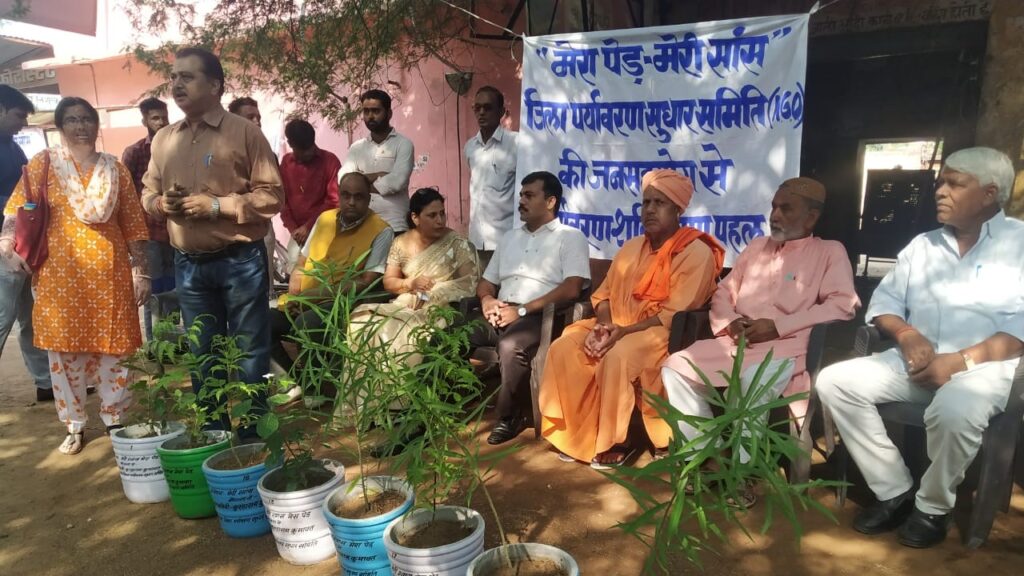
The sad state of environment in Rajasthan attracted the attention of the founder of Zila Paryavaran Sudhar Samiti (ZPSS). His initial efforts were limited to creating awareness among people on environmental issues through use of opportunities like celebration of World Environment Day. This is continuing till date, while addressing other pressing problems of the populace. Solution of these problems definitely has a bearing on environment of the area.
Recently, more concerted efforts are being made for protection and conservation of forests in Jhunjhunu district to enhance forest area and livelihood opportunities people dependent on forests. The idea is to contribute to environmental protection and socio-economic development through afforestation and biodiversity conservation.
So far microplans of 12 villages in three forest ranges in Jhunjhunu district have been prepared and village level Forest Protection and Management Committees formed. These committees have been imparted training and extension camps organised for them. People based on forests have been identified and their 30 SHGs formed. So far 21 SHGs have been associated with income generation activities, 21 given revolving fund and 25 given loans from banks. Nearly 50,000 saplings have been planted to improve forest cover.